

If you’ve ever searched for the definition of “Business Consulting,” you’ve likely been met with a wall of corporate jargon: synergy, organizational restructuring, value-added frameworks. For a founder or a leader in the early stages, that language doesn’t help. It just adds to the chaos.
In this beginner’s guide, I am stripping away the suit and tie. We’re looking at what consulting actually is, why people use it, and how it can help you move from a state of “overwhelmed” to a state of “execution.”
Feeling stuck with too many ideas and no direction? That’s where structured consulting turns chaos into clarity.
The Simple Definition: A Strategic Sounding Board


At its simplest, business consulting is the practice of hiring an outside perspective to help solve a specific problem or achieve a specific goal.
But let’s go deeper: Consulting is external, independent decision support for owners and leaders who are navigating complexity, uncertainty, or change. At its core, it is not about advice in isolation. It’s about helping someone think clearly about a problem they are already responsible for solving.
Think of a consultant as a GPS for a road you’ve never driven. You are still the one driving the car; you own the vehicle and the destination. But the consultant is the voice beside you saying: “There’s a traffic jam two miles ahead; let’s take this shortcut instead.”
When Do People Typically Reach Out to a Consultant?
Most beginners think you only reach out to a consultant when something is “broken.” While “fixing things” is part of the job, most modern consulting is actually about acceleration and clarity. Whether you are looking to Validate a raw idea, Optimize a running operation, or Pivot a business that has hit a wall, the need for a partner usually boils down to three things:
- The Context Gap: You are too close to your business to see the bottlenecks. You need a “Strategic Mirror” to show you what’s really happening.
- Specialized Expertise: You’re a great product creator, but you’ve never scaled a team or built a cross-border strategy. You’re “renting” years of experience to save yourself months of trial and error.
- The Need for Speed: You have a vision, but you don’t have the time or money to figure out the “how” through guesswork and inefficient fund allocation.
The “Intrigue” of Strategy: Beyond the Spreadsheet
Many consultants will walk into a room with a 50-page slide deck full of data. But data without “logic” is just noise.
In my work with founders, I’ve often observed a recurring challenge: a deep, optimistic belief in a specific path, often driven by intuition rather than the data or experience needed to back it up. When this optimism meets the traditional way of planning—starting with today and trying to predict an uncertain future—it almost always leads to “Execution Bloat.”
This is why I prefer a different lens: a proprietary framework I call RLS.
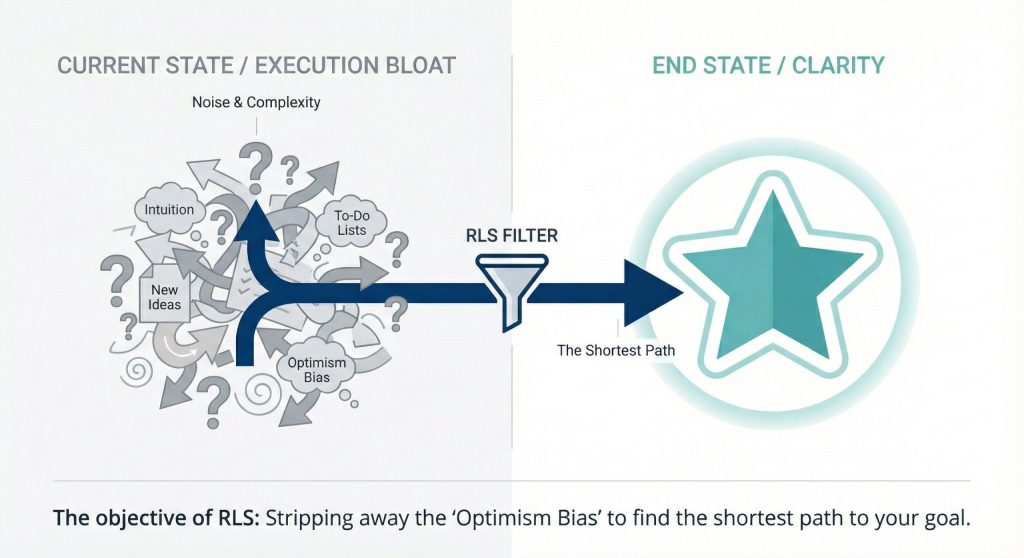
While the technical mechanics of RLS are best explored in a focused session, its objective is simple. It is designed to strip away the “optimism bias” and identifies the one or two things that actually move the needle for your specific context.
This is the difference between “being busy” and “being strategic.
Common Myths About Business Consulting
- “I’m too small for a consultant.” Actually, the best time for consulting is before you’ve spent your budget on the wrong things. Even a single “Clarity Session” can save a startup thousands of rupees in wasted marketing or tech spend.
- “They’ll just tell me what I already know.” A good consultant might tell you what you suspect, but they provide the evidence and the execution plan to act on it. They turn your “gut feeling” into a “business case.”
Is It Time for You to Seek an Outside Perspective?
If you are currently “New to a Role,” launching a startup, or feeling that your business has plateaued, take a moment for a quick Self-Audit:
- The Roadmap Test: Do I have a clear 90-day roadmap with 3 specific priorities, or am I just reacting to my long to-do list?
- The Alignment Test: Is my team (or my co-founder) aligned on a single, shared strategic logic, or is everyone running in different directions?
- The Problem Test: Am I solving a symptom (like low traffic) or the actual disease (like a weak value proposition)?
If the answers to these aren’t clear, you don’t need more “work”—you need more clarity.
The Bottom Line
Business consulting isn’t about having all the answers; it’s about asking the right questions. It’s a human partnership designed to reduce the “Cost of Bad Decisions.”
If you are at a stage where you don’t just need motivation — but also a map, a mindset shift, and a method — then working with the right consultant can change how you build your business from the ground up.
Are you ready to find your next move? If you’re looking for a sounding board to help you navigate your current crossroads, let’s have a conversation.